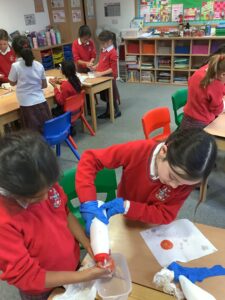
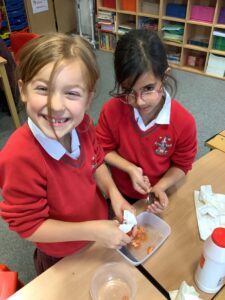
Form 1 brought their History lessons to life this week with a rather unusual experiment: mummifying tomatoes!
As part of their topic on Ancient Egypt, pupils have been exploring the fascinating beliefs, traditions and everyday practices of this ancient civilisation. This week, their attention turned to mummification and the extraordinary methods the ancient Egyptians developed to preserve the bodies of the dead.
Rather than simply reading about the process, Form 1 had the opportunity to try out some of the techniques themselves, with tomatoes standing in for the mummies!
Working carefully and methodically, the pupils began by removing the insides of their tomatoes. They then filled them with a salt mixture, recreating the role of natron, a naturally occurring salt that was used by the ancient Egyptians during the mummification process to help dry and preserve bodies.
Once their tomatoes had been prepared, it was time for the final stage: wrapping their miniature mummies in tissue ‘bandages’. There was plenty of concentration, curiosity and, unsurprisingly, a little mess along the way!
The practical activity gave pupils a memorable way to explore the different stages involved in mummification and helped them understand how and why the ancient Egyptians used these preservation techniques thousands of years ago.
The experiment isn’t over yet, however. The tomato mummies will now be left for 70 days, reflecting the length of time associated with the ancient Egyptian mummification process. Over the coming weeks, pupils will be able to observe their tomatoes and see how they change as the salt begins to do its work.
Form 1 are already keen to discover what their mummies will look like at the end of the process, although they will need to be patient before the final results are revealed!
It was a brilliantly hands-on History lesson that combined careful observation with plenty of fun, and certainly brought the world of Ancient Egypt to life in the classroom.