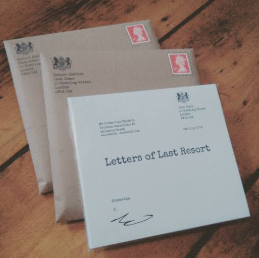
The Letters of Last Resort
By Rowena Cole, Head
We will all face moments of uncertainty in our lives.
There will be times when the right course of action is not immediately clear; when competing responsibilities pull us in different directions; when there is no obvious answer and when, ultimately, a difficult decision simply must be made.
Few decisions, however, could be more difficult than the writing of the Letters of Last Resort.
Last week, while attending a conference, I listened to a keynote address by Joe Garner, an experienced and accomplished former CEO now working as an advisor to CEOs across public and private sector, about ‘leading with humanity’. Drawing upon his leadership experiences across a range of organisations, he reflected on moments when he had faced genuinely difficult decisions and, importantly, what he had relied upon when certainty was simply not available.
Like many thoughtful leaders, he has drawn on different ethical frameworks throughout his career and has continually reflected on how he might become a better leader. But one example he shared particularly stayed with me: the Letters of Last Resort.
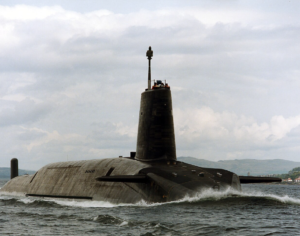
I had not come across these before, although they appear in the news whenever a new Prime Minister takes office. Soon after entering Downing Street, every British Prime Minister is required to write four identical handwritten letters. One is placed aboard each of the United Kingdom’s nuclear-armed submarines. Their contents are known only to the Prime Minister.
The letters contain instructions for what a submarine commander should do if the UK has suffered a catastrophic nuclear attack and both the Prime Minister and their nominated deputy are dead or otherwise unable to give orders.
It is difficult to imagine a decision carrying greater weight.
The contents of the letters remain secret. When a Prime Minister leaves office, their unopened letters are destroyed, and their successor writes new ones. It is generally understood, however, that the instructions available to a Prime Minister broadly include four possibilities: retaliate; do not retaliate; place the submarine under the command of an allied nation; or leave the decision to the commander in charge.
What would you do?
I invited the pupils during Assembly to put up a show of hands for which option they would settle on.
It was split, but in the main, like myself when I was asked the same question at the Conference, chose the third option: place the submarine under the command of an ally.
In the conference, after our vote, Joe shared two very different attempts to answer the same question.
One was generated by AI. It ultimately authorised the use of nuclear weapons only if all peaceful alternatives had been exhausted and the nation’s survival remained under imminent threat. In other words, that if all else fails, then we have no choice but to also inflict pain and suffering.
The other came from Dr David Rodin, a leading scholar of the ethics of war and conflict. His response took a profoundly different path. He argued that if the commander were reading the letter, the nuclear deterrent had already failed in its purpose. Retaliation could not restore those who had been lost. Instead, it would inflict unimaginable suffering upon millions of other people, many of whom bore no responsibility for the original attack. His words stayed with me:
“I know that the desire for revenge must be strong – you would not be human if you did not feel this. But reflect on the meaning of retribution. The civilians whose lives you would destroy – the teachers, parents and postmen – were not the ones responsible for the attack on Britain.
To seek revenge on the guilty by attacking the innocent is not just iniquitous; it is incoherent.”
His words spoke of values that can guide actions even in moments of the greatest uncertainty. The circumstances are almost impossible for most of us to comprehend. Yet the underlying question is relevant to every one of us: When there is no easy answer, what will guide you?
When there is no easy answer, what will guide you?
Most of the decisions we face will, thankfully, never carry consequences remotely approaching those contained within a Letter of Last Resort. But all of us will experience uncertainty. We will face moments when the rules do not quite provide the answer; when other people cannot make the decision for us; when doing what is easiest and doing what is right may not be the same thing. In those moments, what do we call upon?
I hope education prepares young people for far more than examinations, qualifications or careers. I hope it helps them develop an inner compass: a sufficiently strong sense of who they are and what they stand for that, when certainty disappears, they still have something upon which to draw. And, perhaps above all, humanity.
It is not beyond the bounds of possibility that one pupil, perhaps several pupils, at LEH could one day become Prime Minister. They might sit alone in Downing Street, newly appointed to the highest political office in the country, and be presented with four blank sheets of paper on which they must write their Letters of Last Resort.
Whether faced with that or any other moment of uncertainty in their lives, my hope is that their education and experiences will have helped them develop the judgement to think carefully, the integrity to remain true to their values, the wisdom to recognise complexity and the courage to take responsibility for the path they choose.
Leading with humanity does not mean that every decision becomes easy. Quite the opposite. Leadership sometimes means accepting that there is no perfect choice. It means being prepared to think deeply about the consequences of our actions, particularly their consequences for other people, and having the courage to remain true to our principles when circumstances put them under the greatest pressure. Above all, I hope they will take a moment to remember to lead with humanity.
Bold Beginnings start here.
If you would like more information on The Letters of Last Resort, there is a BBC News article online from 2016 here.