

The Benefits of All-Girls Schools: Confidence, Achievement and Opportunity
by Rowena Cole, Head
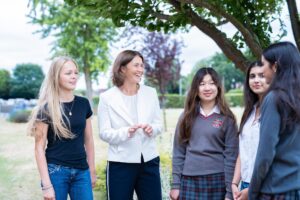
It has long been recognised that an all-girls education offers distinct advantages over a co-educational setting. It is therefore no surprise that the latest report from the Girls’ Schools Association, drawing on data from the Department for Education and UCAS, shows that girls in single-sex schools consistently achieve higher GCSE and A level grades than their peers in mixed schools.
UCAS data also shows that girls are the majority in degree subjects such as English, Languages and Creative Arts, meaning they already lead in humanities pathways nationally. At the same time, participation in Science, Technology, Engineering and Mathematics at A level is significantly higher among girls in all-girls’ sixth forms than among those in co-educational settings. Girls in these schools are 2.9 times more likely to take Further Mathematics and 2.3 times more likely to take Physics. They are also more likely to study the sciences more broadly, with higher participation in Biology and Chemistry.
Beyond school, students from all-girls’ sixth forms are significantly more likely to pursue STEM subjects at university, including medicine, veterinary science and dentistry. This progression continues into careers. Half of alumnae surveyed have worked in a STEM-related field at some point, despite women making up only a small proportion of the overall STEM workforce. At LEH we have seen an increase in girls choosing to study Medicine, Veterinary Science and Dentistry with 100% of those girls this year being offered places at universities including Oxford, University College London, King’s College London, the University of Bristol University and the University of Edinburgh.
This success is particularly significant considering recent research into girls’ mathematical achievement. A large-scale study published in Nature found that boys and girls begin formal education with similar mathematical abilities, but that a gender gap can emerge during the first year of schooling. Researchers suggested that factors within educational environments may play an important role in shaping pupils’ confidence and attainment in mathematics. At LEH, we see a different story. In an all-girls environment, our pupils develop the confidence to embrace mathematical challenge, pursue STEM subjects in large numbers and achieve outstanding outcomes. Their success demonstrates that gender gaps in mathematics are not inevitable and that, in the right environment, girls can flourish academically and develop a lifelong confidence in their abilities.
While this progress in STEM is significant and it’s wonderful to see more girls heading in this direction, the case for an all-girls education extends further. The World Economic Forum highlights that the future workforce will depend not only on technical knowledge but also on human skills. As artificial intelligence reshapes the workplace, skills such as critical thinking, communication, creativity and leadership are becoming increasingly important. Its Future of Jobs research identifies analytical and creative thinking, resilience, flexibility, leadership and curiosity among the most in-demand capabilities.
“I’ve always enjoyed science, but I didn’t want to give up essay writing. Combining them felt like the best way to build a broad skill set and allow me to follow either a scientific or humanities degree at university.”
Lower Sixth Student
These are the very skills developed through subjects such as Humanities subjects such as English, History, Languages and the Arts. Girls already excel in these areas nationally, and an all-girls education strengthens this further through high academic achievement and the confidence to express ideas, challenge thinking and lead. UCAS data shows that that girls are consistently more likely than boys to combine STEM subjects with humanities or arts at a level, a trend we see at LEH, thereby giving them a balanced set of skills for the future and therefore an advantage when pursuing future careers.
“Combining science with English has given me both technical understanding and strong communication skills. As AI becomes more common, I think being able to think critically, interpret information, and communicate clearly will open-up wider career opportunities in the future.”
Upper Sixth Student
Research also shows that girls in independent girls’ schools are more likely to develop the confidence to take on leadership roles across a wide range of fields. Through extensive co-curricular opportunities, strong academic enrichment and a learning environment free from gender stereotypes, students are supported to pursue their interests without limitation. The result is young women who combine academic excellence with confidence, resilience and ambition.
By giving our pupils, the bold beginnings to pursue their dreams, they have the skills and confidence to become doctors or editors, coders or campaigners, scientists or barristers, engineers or linguists or whatever their chosen career may be.
The lasting value of an all-girls education
The impact of an all-girls education can be seen in the achievements of our alumnae. From medicine and finance to technology, law, the creative industries and beyond, LEH students go on to build successful careers across a remarkable range of fields. Their journeys demonstrate the power of a learning environment that encourages ambition, nurtures confidence and inspires girls to pursue their passions without limits. Our recent Alumnae magazine, Holles Connect, gives lots of examples of this from Dr. Deborah Horner, Class of 1995, whose career in maternal critical care is transforming outcomes for women and their families, Rachel Mann, Class of 2011, Vice President at BlackRock who is supporting women in Finance through her Future Leaders Network, to entrepreneurial sisters Shafali Shown-Keen and Anisha Sharma (Class of 1999 and 2000) and Celia Birchall (Class of 2018) who’s time at LEH gave them the courage to branch out and follow their dreams.
“You were encouraged to speak up, share your ideas and believe that your voice mattered.”
Shafali Shown-Keen, Class of 1999
“School gives you the foundation that stays with you, even if you don’t realise it at the time.”