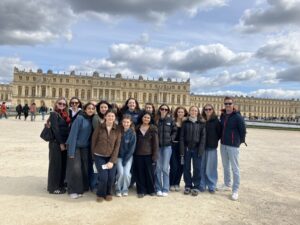
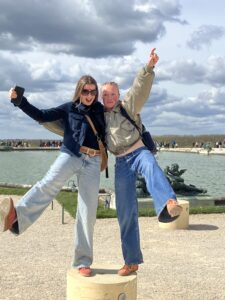
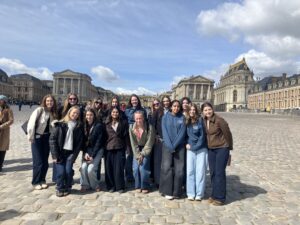
A group of passionate Lower and Upper Sixth historians set off on a trip to Paris to explore the opulence of Versailles to the sombre remnants of the French Revolution. One of our students, Amelia tells us more about the trip:
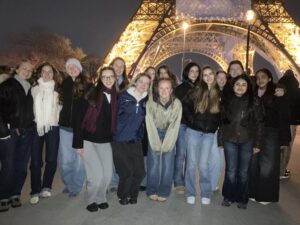
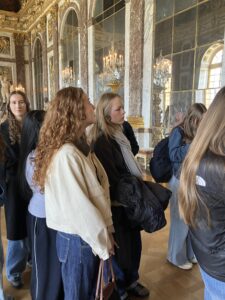
“After waking up bright and early, the Lower 6 and Upper 6 historians embarked on the Eurostar to Paris. After a quick stop off in the Gare du Nord, we got on a coach to Versailles. There we met a tour guide who took us around the gilded palace and showed us the private chambers of Louis XVI and Marie Antoinette, then into the equally impressive throne room, which commemorated Napoleon’s war victories. Following this, we walked around the grounds and particularly enjoyed seeing the Petit Trianon and the Queen’s Hamlet, both of which had been ornately designed according to the wishes of Marie Antoinette. After some free time, spent exploring the gift store, we headed back to the hostel to get ready for dinner. After a lovely dinner, we set out on the metro to see the Eiffel Tower at night, and watched it sparkle whilst eating Parisian crepes.
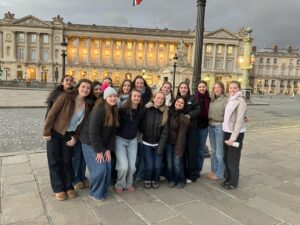
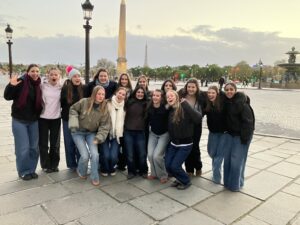
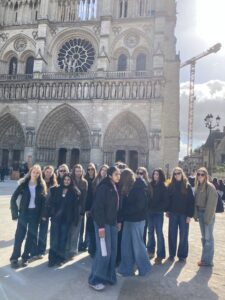
The next day, following a good night’s sleep, we set out on a busy walking tour around the key revolutionary sights of Paris, including the Picpus Cemetery, where The Marquis de Lafayette along with the mass graves of over 1300 Terror victims were buried, and the Place de la Concorde, where the guillotine was primarily located during the Terror. After a stop off to see the Notre Dame, we were allowed to go shopping and get some food for lunch, many of us making authentic Parisian sandwiches, and visiting a vintage clothing store. Later that day, we went to see the Conciergerie Prison, where Marie Antoinette was imprisoned in 1793, along with many other female victims of the Terror. That night we took another metro ride to the Champs-Elysées, and saw the Arc de Triomphe in the evening, before heading back to the hostel for an early night.
On our final day in Paris, we begun with a visit to the Pantheon, in the Latin Quarter where the remains of several key French figures are buried, including the Enlightenment figures of Voltaire and Rousseau, and infamous authors Victor Hugo and Alexandre Dumas as well as Marie Curie, the first woman to be interred on her own merits. Afterwards, we went to the tomb of Napoleon Bonaparte in the Hotel des Invalides, and we were all amazed by the size and the intricacy of the monument. We rounded off the trip with a visit to the Musee de l’Armee and we explored the weaponry used by Napoleon’s armies during his military expeditions, including a particularly impressive, preserved horse, which was on display. To round off the day, we headed back to the Gare du Nord, to get on the Eurostar back to St. Pancreas. It was a great trip, and we saw so many interesting and fascinating historical sights!”